
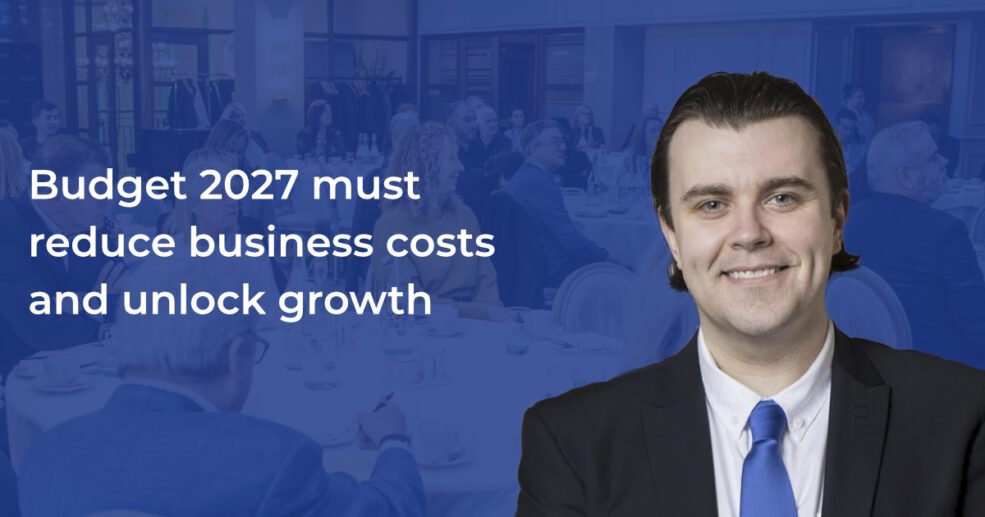
Limerick, 27 July 2026: Limerick Chamber is calling on Government to use Budget 2027 to reduce the cumulative cost burden on enterprise and accelerate the delivery of housing and enabling infrastructure, after its latest Business Sentiment Survey found that rising costs are changing investment, pricing and recruitment across the Mid-West.
Nine in ten respondents reported higher operating costs than 12 months ago, with more than half experiencing an increase of at least 10%. Half reported absorbing costs through lower margins, while 45% increased prices to customers, 30% delayed investment, 29% have reduced expansion plans and 27% have deferred recruitment. Overall, 48% have cancelled, delayed or reduced major investment because of rising costs.
The survey also shows that the appetite to grow remains strong. 69% of respondents intend to invest over the next six months, 40% expect to increase their workforce and only 7% expect employment to fall. Limerick Chamber said the findings are not contradictory: businesses still intend to invest, but higher costs are reducing the scale of projects and delaying decisions.
Seán Golden, Chief Economist and Director of Policy at Limerick Chamber, said:
Mid-West businesses are ready to grow. The question is whether the operating environment allows them to act. There is a critical difference between businesses wanting to invest and businesses being able to invest,
Business resilience must not be mistaken for unlimited capacity to absorb additional taxation, regulation and operating costs. When margins, investment and recruitment are already being adjusted, further employer operating-cost burdens would weaken the growth that Budget 2027 should be seeking to unlock.
Three critical outcomes sought from Budget 2027
- Reduce cumulative business costs. Avoid new employer and operating-cost burdens and assess the combined impact of energy, employment, insurance, taxation, regulation and compliance costs on investment and jobs.
- Accelerate housing and enabling infrastructure. Fund and publish delivery timelines for Mid-West housing, water, energy, grid and transport capacity so businesses can recruit, expand and bring projects into operation.
- Strengthen accountability for delivery. Define responsibility for strategic projects and publish milestones at national, regional and local level so investors can plan with confidence.
Housing and infrastructure constrain growth
Housing supply and affordability were the most frequently cited constraints on the Mid-West’s competitiveness, selected by 70% of respondents. Planning delays and inadequate water, energy and grid infrastructure followed at 59%, while 35% cited transport and mobility.
Limerick Chamber said these are enterprise issues as well as public service challenges. Insufficient housing makes it harder to attract and retain workers, while gaps in water, grid, energy, and transport capacity delay projects and restrict the regions ability to accommodate investment.
Commercial rates compound cost pressure
The survey also tested how businesses would respond to a further increase in commercial rates. Six in ten SMEs in the sample describe themselves as sensitive to higher rates, compared with half of large organisations. Respondents indicated that higher rates could lead to lower margins, higher prices for customers, delayed investment and reconsideration of premises or expansion plans.
Limerick Chamber is therefore urging local authorities to consider commercial rates within the wider cumulative cost base and to avoid increases that would further restrict investment. This is a separate decision from Budget 2027, but forms part of the same competitiveness challenge.
Golden, said:
Commercial rates are not economically neutral. They are a fixed cost attached to maintaining a physical presence and investing in a location. An increase in commercial rates can weaken margins, increase prices to consumers, discourage premises investment and erode the commercial base on which future rates income depends. Budget 2027 and local authority budget decisions must avoid adding further pressure to already constrained businesses.
Local Governance clarity matters for investor confidence
77% of respondents expressed concern that uncertainty around roles and decision-making could affect project delivery, investor confidence or Limerick’s reputation. Sixty per cent reported that perceived uncertainty was negatively affecting their confidence to conduct business, invest or expand in Limerick. Limerick Chamber said those perceptions should be addressed through clear responsibilities, transparent decision pathways and regular milestone reporting.
Investors and business leaders assess whether institutions can make decisions, resolve obstacles and deliver projects within credible timelines be it at a local or national level. Ambiguity creates delay, delay increases risk, and higher risk weakens investment. When it comes to local Government administration, businesses are asking for clear responsibilities, transparent decision pathways and visible accountability for delivery.
At the same time, 73% do not believe the Government is helping to reduce the cost of doing business. Budget 2027 must that cycle.
The Mid-West business community is not asking Government to manufacture growth. Businesses are already prepared to invest, recruit and innovate. What they need is an operating environment that allows those intentions to become real economic activity. Budget 2027 should help unlock the investment businesses are ready to make. That means protecting businesses from new cost burdens, funding the infrastructure on which growth depends and providing clear accountability for delivery. Local authority budget decisions should reinforce that effort by avoiding commercial rates increases that would add further pressure.
Limerick Chamber said the positive investment pipeline represents a significant opportunity for Budget 2027, but one that could be lost without immediate action on competitiveness.
The investment appetite exists, but projects are being tested against a structurally heavier cost base, infrastructure deficits and greater geopolitical uncertainty. Budget 2027 must release investment that is currently being delayed or scaled back. Relying on companies to continually absorb higher costs is not an economic strategy.