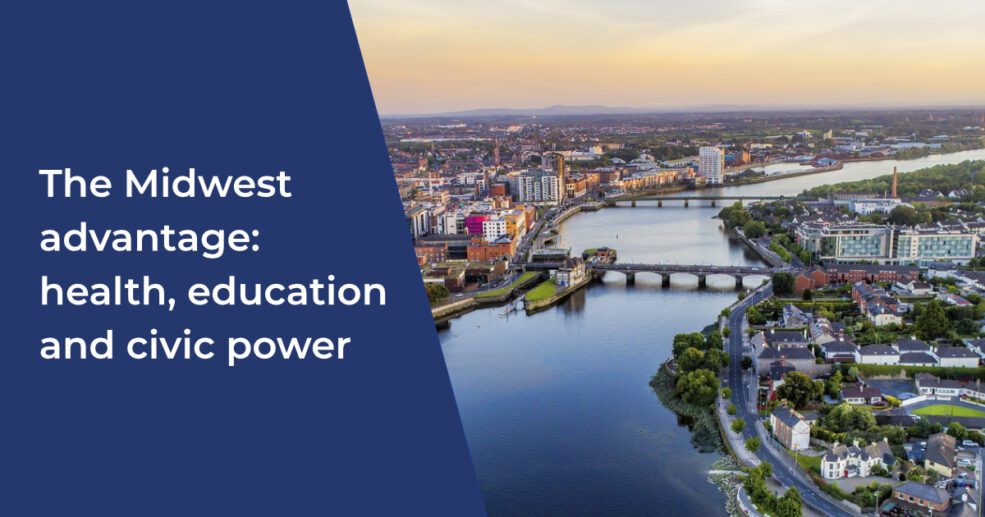
The Irish Midwest is much more than a collection of distinct counties. With a population of over 413,000 people spread across Limerick, Clare, and Tipperary, our region operates as a highly dynamic, interconnected system. For business leaders and civic stakeholders, understanding the pulse of this macro-region is essential for driving sustainable economic growth and making informed strategic decisions.
At the heart of our local economy lies a powerful triad: public administration, education, and healthcare. These sectors do not operate in isolation. Local government shapes the physical and economic infrastructure we rely on. Education serves as the critical pipeline supplying our high-tech, medical, and professional workforces. Meanwhile, a robust healthcare system relies heavily on local graduates for staffing and council-led initiatives for community wellness.
We have incredible foundational strengths to draw upon, from our status as a thriving ‘Knowledge Hub’ to the historic introduction of a directly elected Mayor in Limerick. However, to truly harness our potential, we must also have honest conversations about our structural hurdles, such as rural healthcare capacity and educational disparities. By understanding how these sectors interlock, Chamber members can identify meaningful opportunities to collaborate, innovate, and elevate the entire Midwest.
The Civic Engine Driving Regional Strategy
Public administration is the bedrock of our regional development. Following the Local Government Reform Act 2014, our councils shifted from fragmented entities into unified, county-wide authorities capable of executing ambitious, large-scale strategies.
Limerick City and County Council acts as a powerful regional anchor. Backed by a dedicated workforce of approximately 1,500 staff, it is now uniquely positioned under the leadership of Ireland’s first directly elected Mayor, John Moran. This new executive power provides an unprecedented opportunity to drive strategic planning and advocate for the Midwest on a national stage.
Meanwhile, Clare and Tipperary councils are actively managing expansive territories to ensure geographic parity. Tipperary operates a dual-centre model across Nenagh and Clonmel to serve its large population effectively, while Clare County Council, with 984 staff, balances the demands of a rapidly growing tourism and renewable energy sector. We also see fantastic cross-county collaboration already in motion. The Limerick-Shannon Metropolitan Area Strategic Plan is a prime example of an engine designed to grow Limerick City’s population to 150,000 by 2040, creating a ripple effect of commercial opportunity across the surrounding areas.
Fuelling the Midwest Knowledge Hub
If the local government provides the infrastructure, our education sector provides the vital human capital. The Midwest is rightfully recognised as a premier Knowledge Hub, supported by three major tertiary institutions that collectively enrol over 38,000 students.
The University of Limerick (UL) stands out as a leading research institution, while the Technological University of the Shannon (TUS) focuses heavily on applied learning. Crucially for local businesses, TUS maintains the highest graduate employment rate in Ireland, ensuring a steady stream of job-ready professionals across its campuses in Limerick, Clare, and Tipperary. Furthermore, Mary Immaculate College continues its legacy of excellence in teacher education.
However, a closer look at our educational landscape reveals areas where we can offer greater support. While 40% of Clare residents and 39% of Limerick residents hold a third-level qualification, Tipperary currently sits at 33%. This disparity acts as an economic bottleneck for transitioning more of our population into high-value service sectors. Expanding the capacity of vocational training networks, such as the Limerick and Clare Education and Training Board and the Tipperary ETB, will be vital. By championing apprenticeships and green-tech upskilling, we can help bridge this gap and integrate more talent into our high-tech economy.
Navigating Healthcare Challenges and Capacity
Healthcare remains our most complex challenge, defined by exceptional clinical expertise that is currently constrained by severe systemic pressures. The sector is undergoing a massive transition under the Sláintecare model, led by the HSE Mid West, aiming to better integrate hospital and community care.
The acute capacity constraints at University Hospital Limerick (UHL) are a pressing concern for all of us. As the only Model 4 hospital in the region, UHL faces overwhelming demand, recording over 80,000 emergency presentations last year. A recent HIQA review highlighted a severe inpatient bed deficit as the primary risk to patient safety, recommending major expansions on-site or the development of a completely new Model 3 hospital. Delivering on these healthcare infrastructure expansions is an absolute priority to secure patient safety and restore public trust.
Beyond the hospital doors, primary care faces its own hurdles. We are approaching a ‘retirement cliff’ among General Practitioners, which is creating a sharp urban-rural divide. While South Limerick City enjoys strong GP coverage, areas like East Clare have the lowest GP density in Ireland. Stabilising primary care through targeted recruitment and community incentives is essential for keeping our rural workforces healthy and supported.
Finding Opportunity in Cross-Sector Collaboration
The challenges we face are significant, but they also present clear opportunities for the business community to step up. Effective service delivery in the Midwest increasingly relies on creative, inter-agency cooperation.
Take the Limerick Food Partnership, a brilliant joint initiative between the Council, the HSE, and local education boards to combat food insecurity. Consider the HAPPEE Project, where UL partners with local primary schools to place occupational and speech therapy students directly into educational settings for early intervention. Even the Equine Education programme in Limerick shows how local government regeneration projects can link animal welfare to tangible vocational pathways.
These initiatives prove that when public administration, education, and health collaborate, the entire community benefits. For Chamber members, these partnerships highlight the value of engaging with public sector initiatives. Whether it is offering mentorship, aligning corporate social responsibility goals with local health boards, or partnering with educational institutions for bespoke training programmes, your business can be a catalyst for regional improvement.
Your Role in the Midwest’s Next Chapter
The Irish Midwest has serious momentum. With employment growing by 6% recently and massive expansions in professional services, health, and education, the foundation for long-term prosperity is solidly in place.
As business leaders, we have a vital role to play in sustaining this growth. How can your organisation support compact urban regeneration to house our growing workforce? What practical steps can you take to partner with local vocational boards to upskill the next generation of workers?
By engaging actively with our newly empowered local government, supporting our educational institutions, and advocating for necessary healthcare expansions, we can collectively ensure the Midwest remains an exceptional place to live, work, and do business. Let us use our shared expertise to turn regional challenges into our greatest competitive advantages.