
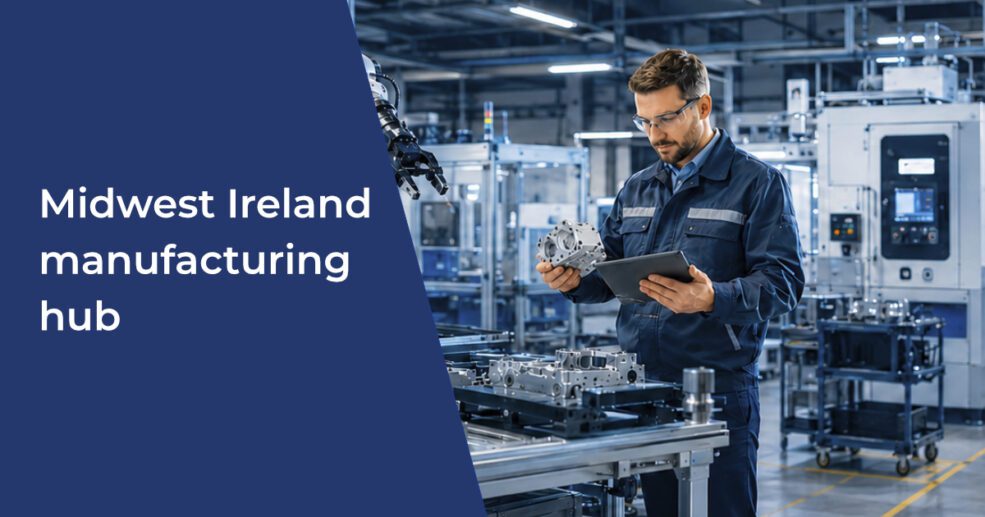
If you run a business in Limerick, Clare, or Tipperary, you already know that our region has a strong industrial heritage. You see the facilities, hear the announcements, and likely work alongside the companies driving our local economy. But stepping back to view the complete picture reveals something truly remarkable. The Midwest has quietly transformed into a highly sophisticated, globally competitive powerhouse for advanced manufacturing and engineering.
Right now, 153 multinational corporations operate across the region, directly employing over 27,000 people. These global giants are deeply integrated with a vibrant community of indigenous small-to-medium enterprises. Together, they form an ecosystem that generates 40.9% of the Mid-West region’s total Gross Value Added. This is the highest reliance on industry among Ireland’s NUTS 3 regions outside the South-West, proving that engineering is the primary engine of our local economy.
For business owners, entrepreneurs, and decision-makers in the Limerick Chamber, understanding the sheer scale of this sector is vital. The landscape is shifting rapidly toward digital transformation, green energy, and advanced therapeutics. By exploring the data, infrastructure, and upcoming trends, you can position your own business to seize new opportunities, secure lucrative partnerships, and drive measurable success in the years ahead.
A manufacturing powerhouse built on deep sector expertise
The strength of the Midwest lies in its diversity. We do not rely on a single industry. Instead, the region has cultivated deep expertise across several high-value sectors, creating a resilient and dynamic business environment.
Medical technology and life sciences
The life sciences sector is a dominant pillar in the region. In Clonmel, Tipperary, Boston Scientific and Abbott operate massive manufacturing hubs for cardiovascular and active implantable devices. Limerick is home to Johnson & Johnson Vision Care, which runs a highly automated contact lens manufacturing site, alongside Cook Medical.
Clare is also breaking new ground. MeiraGTx recently opened a 150,000-square-foot commercial-scale gene therapy manufacturing facility. As the first of its kind in Ireland, this site produces viral vectors and plasmid DNA, firmly placing the Midwest at the forefront of global genetic medicine.
Semiconductors, aerospace, and precision engineering
Our capabilities extend far beyond healthcare. Analog Devices operates its European regional headquarters and a major wafer fabrication plant in Limerick, bolstered by a recent €630 million capacity expansion.
The Shannon Free Zone in Clare anchors the aerospace sector. Major Maintenance, Repair, and Overhaul providers like Lufthansa Technik Turbine Shannon and Atlantic Aviation Group lead the charge. Crucially, indigenous precision engineering firms such as Takumi Precision Engineering, Dawnlough, and DPF Engineering act as essential supply chain partners, demonstrating how local SMEs can thrive alongside global giants.
Future mobility, space-tech, and agri-engineering
The Midwest is successfully diversifying into complex “hard-tech” niches. Jaguar Land Rover and General Motors operate advanced software engineering hubs for autonomous vehicles in Clare and Limerick.
In the emerging space sector, Mbryonics is establishing a 40,000-square-foot manufacturing facility in Shannon. By 2027, they plan to produce 5,000 optical satellite communication terminals annually. Meanwhile, Tipperary-based Buttimer Engineering continues to expand its bulk material handling systems and steel fabrication business, recently announcing plans to double its workforce to over 400 by 2028.
The economic engine driving regional growth
The numbers tell a compelling story of growth and high performance. The apparent productivity of the Mid-West region stands at an impressive €124,555 per person employed in 2024.
We are also seeing historic employment growth. The region recorded a 6% increase in employment in 2024, achieving the highest regional growth rate in Ireland. When you consider that engineering employment across Ireland grew by 44% over the last decade, vastly outpacing the national average of 29%, it becomes clear that the Midwest is a primary beneficiary of this upward trajectory. Regional export trade facilitated by the Shannon Foynes Port is currently valued at €8.5 billion annually, highlighting the massive logistical advantage of our local infrastructure.
An ecosystem designed for collaboration and innovation
Success on this scale does not happen by accident. It requires a highly integrated business ecosystem, world-class facilities, and a reliable pipeline of skilled talent.
World-class infrastructure and facilities
The Shannon Free Zone is Ireland’s largest multi-sectoral business park. It provides nearly 1 million square feet of commercial space, recently enhanced by a 148,000-square-foot expansion for high-grade logistics and R&D. Tipperary’s Ballingarrane Science & Technology Park serves as a dedicated focus for MedTech enterprise.
For research and digital transformation, the National Technology Park in Limerick bridges academia and industry. It hosts Digital Manufacturing Ireland, a €40 million centre helping businesses navigate digital upgrades. Nearby, the Future Mobility Campus Ireland provides a real-world testing environment for drones and autonomous vehicles.
A highly skilled talent pipeline
Engineering roles in Ireland are lucrative, commanding salaries 14% higher than the national average. Because regional unemployment is historically low, competition for talent is fierce.
Fortunately, our educational institutions deliver exceptional support. The University of Limerick operates a massive Cooperative Education programme with 2,200 annual placements, yielding a 97% graduate employment rate. The Technological University of the Shannon celebrated a record 3,800 graduates in 2024, alongside a 62% increase in PhD and Masters by Research graduates. Industry-led upskilling, such as the Certificate in Leadership in Digitisation of Manufacturing, provides practical tools to help your existing workforce adapt and grow.
Powerful industry networks
- Collaboration is a defining characteristic of the Midwest. Formalised industry clusters provide SMEs with actionable insights and strategies to drive measurable success:
- IDEAM Cluster: A one-stop-shop network of 123 members helping SMEs navigate digital and green transitions.
- Emerald Aero Group: Over 10 indigenous SMEs sharing resources and R&D to supply the global aerospace market.
- LINC Engineering Network: Fostering the “Meitheal” concept, this network enables over 50 members to share equipment, sub-contract, and jointly bid on larger tenders.
- Mid-West Lean Network: Driving productivity and operational excellence across the supply chain through shared practices.
Future opportunities for Midwest businesses
The future holds incredible potential for those ready to innovate. The Shannon Foynes Port’s Vision 2041 masterplan identifies the Atlantic coast as possessing world-class wind resources. The port aims to become an integration hub for Floating Offshore Wind, potentially delivering 30GW by 2050. This could subsequently fuel a gigawatt-scale Green Hydrogen and e-fuels ecosystem, creating massive supply chain opportunities for local engineering firms.
Spearheaded by Digital Manufacturing Ireland and CONFIRM, the region is also transitioning to Industry 5.0. This means moving toward sustainable, human-centric manufacturing that uses AI and data analytics to optimise operations. By engaging with these technologies now, your business can secure a lasting competitive advantage.
Frequently asked questions about the Midwest manufacturing sector
What funding is available for manufacturing SMEs in the Midwest?
The Disruptive Technologies Innovation Fund is a €500 million national fund that heavily supports Midwest-linked projects. Additionally, the Regional Enterprise Development Fund and Local Enterprise Offices provide vital subsidies and grants to assist indigenous SME expansion and innovation.
How does the local infrastructure support heavy manufacturing?
The Shannon Estuary features unrivalled deep-water ports, reaching up to 32 metres deep. This provides a massive logistical advantage for heavy bulk and project cargo. Furthermore, Shannon Airport guarantees transatlantic connectivity, which is crucial for maintaining just-in-time supply chains.
What are the main challenges facing the region’s industrial growth?
High operating costs, specifically regarding energy and labour, remain a challenge. Housing availability also acts as a critical constraint when trying to attract incoming workers. While urban centres like Limerick City and Shannon are highly developed, certain rural parts of Clare and Tipperary still face broadband and transport infrastructure gaps.
Taking the next step in your manufacturing journey
The Midwest has firmly established itself as a vibrant, resilient, and forward-looking manufacturing hub. The combination of global multinational presence, an agile SME base, and exceptional support networks creates an environment where ambition can truly thrive.
Now is the perfect time to review your own business strategy. Look at the clusters available to you, explore the upskilling programmes at UL and TUS, and consider how your company might plug into emerging sectors like offshore wind or advanced therapeutics. By tapping into the resources right on your doorstep, you can drive your business forward and contribute to the continued success of the Midwest region.