
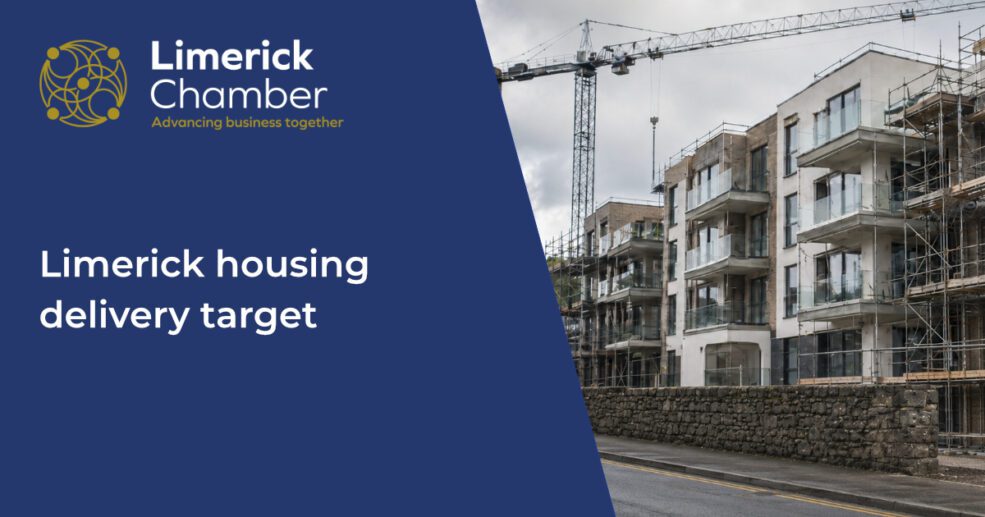
Limerick, 02 June 2026: Limerick Chamber warns that the city is currently nearly 6,000 homes behind housing delivery as Limerick Development Plan proposals fall drastically short of what Limerick needs. While the proposed plan suggests a capacity for 17,000 homes, the Chamber’s independent analysis indicates that only 7,000 are realistically deliverable, highlighting the need for a focused, supportive strategy to house the growing workforce.
In a formal response to Limerick City and County Council’s Proposed Variation No. 3 to the Limerick Development Plan 2022–2028, Limerick Chamber raising serious concerns about the plan’s ability to deliver the homes Limerick urgently needs. The submission follows Limerick Chamber’s recent backing of An Taisce Limerick’s call for greater clarity on stalled city centre residential development, a call both organisations agree is now more urgent than ever.
Recent data underscores that Limerick’s housing output remains deeply inadequate. Housing completions fell by a third in 2025, from 740 in 2024 to 493 in 2025, and first quarter completions in 2026 dropped by a further 19% year-on-year, representing the third consecutive year of Q1 decline and a 31% fall from Q1 2023. The Chamber identifies several constraints limiting the 17,000-home target, including delays on state-owned lands such as Colbert Quarter, unserviced Tier 2 sires and legal or infrastructural barriers on other plots.
“Housing is the single biggest challenge facing our member businesses. Without homes, we cannot attract or retain talent, and without talent, we cannot grow” said Donnacha Hurley, CEO of Limerick Chamber. “Under Limerick’s current rate of delivery, it would take 20 years to deliver the capacity stated under this plan. Even using the more realistic deliverable figure of 7,000 homes would take 8 years to deliver this level of output. There is a clear signal that national policy is not yielding the results required,”
While the variation presents a headline zoned capacity of upwards of 17,000 homes, analysis The Chamber identifies three compounding constraints eroding that headline figure:
State-owned land: A welcome long-term ambition, but these sites, including the Colbert Quarter, announced in 2019 which has not yet progressed to a planning application, are unlikely to deliver within the plan period to 2028.
Tier 2 sites: Designated as “serviceable” but not yet serviced. The delivery of these is at risk due to the chronic Irish Water and grid connection delays.
Other constrained sites: These are sites affected by multiple land folios, legal disputes, lack of sewer connections, or an unwillingness to sell. The track record of delivery where these issues exist is poor.
The City Centre Gap
Since the first round of LDP consultations in 2022, Limerick Chamber has consistently advocated for residential development along the Dock Road and the wider Shannon River corridor. The Chamber is disappointed that Variation No. 3 does not realise the scale of delivery along this corridor that the city requires.
There are two significant landbanks capable of delivering housing in proximity to the city centre: the Greenpark lands and the LDA lands at Colbert Station. The Greenpark lands have owners in occupation and a proven delivery record. The Chamber strongly urges LCCC to revisit the Greenpark lands for appropriate residential zoning as part of this variation.
The Chamber also cautions against an overly restrictive approach to flood zone lands. Much of the city centre falls within a flood zone, and if the LDP does not zone lands capable of passing the Justification Test under National Policy Objective 78 of the National Planning Framework compact urban growth at scale will remain unachievable.
Density Viability and Targets
Limerick Chamber supports densification goals for the city core but flags significant concern regarding development economics and viability in ‘urban neighbourhood’ zones such as Castletroy, Raheen, Mungret, Annacotty, and Monaleen, areas that have historically driven housing delivery, with Limerick City East alone accounting for 51% of city housing completions over the past decade. The Chamber questions whether Limerick City and County Council has conducted a viability analysis for development in these areas under the proposed 50+ dwellings per hectare threshold, and whether, without adequate funding mechanisms, developers will either not build or will rely entirely on Approved Housing Body funding.
The Chamber also questions whether the Council has applied the maximum 50% headroom uplift permitted under Ministerial guidelines, which would yield a target of 3,898 homes per annum, more closely aligned with the Housing Commission’s upper demand analysis than the LCCC Housing Need Demand Assessment figure of 3,208. The Chamber argues the plan should be driven by the higher figure.
Limerick Chamber’s Asks of the Development Plan
Limerick Chamber is calling on Limerick City and County Council to take the following steps before the variation is adopted:
- Adopt realistic site deliverability assessments and build in adequate buffer capacity, formally acknowledging the planning permission attrition rate, currently 64% of permitted homes not commenced.
- Rezone appropriately serviced lands in and near the city core for residential use, including lands capable of passing the flood risk Justification Test under National Policy Objective 78.
- Prioritise the Greenpark lands for large-scale residential zoning given their proven delivery potential, existing ownership in occupation, and proximity to the city centre.
- Accelerate progress on State-owned sites, including Colbert Quarter, and treat these as supplementary to, rather than core components of, the near-term housing supply pipeline.
- Apply the full 50% headroom uplift permitted under Ministerial guidelines, targeting 3,898 homes per annum in alignment with the Housing Commission’s upper demand analysis.
- Publish a comprehensive Housing Delivery Action Plan covering all tenures, not just social and affordable, with tangible delivery actions, active land management mechanisms, and prioritisation of infrastructure for developers who can demonstrate immediate site viability.
By adopting these practical strategies, Limerick can inspire positive development, support its vibrant business community and ensure a thriving future for all residents.